Free PTCB® Practice Test: 90 Questions, 110 Minutes, One Clock
Most things marketed to you as a "full-length PTCB practice test" are ten questions with a scoreboard. This one is 90 questions on a 110-minute countdown, built to the exact specification the Pharmacy Technician Certification Board® (PTCB®) publishes for the Pharmacy Technician Certification Exam® (PTCE®).
The first full-length test is free. Create a free account — no card needed — and the clock starts.
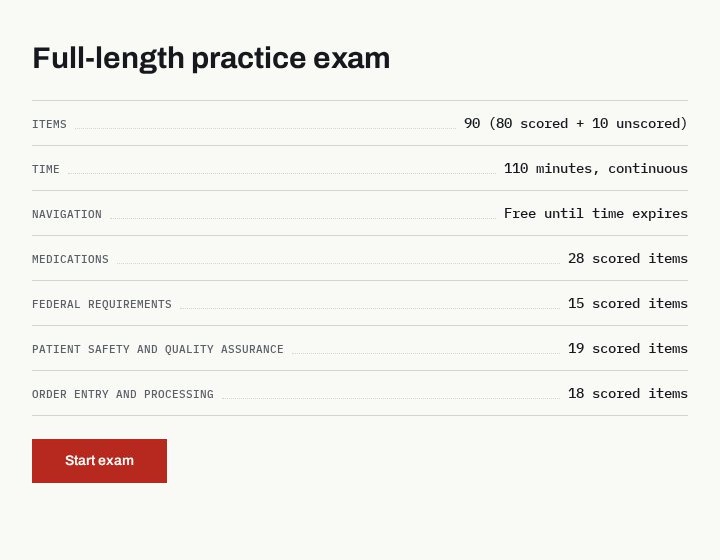
What "full-length" means on this page
Every number below is checkable against PTCB's published exam specification and its content outline effective January 6, 2026. Count them yourself if you like — that is rather the point.
| Specification | This test | The real PTCE |
|---|---|---|
| Total questions | 90 | 90 |
| Scored questions | 80 | 80 |
| Unscored questions, interleaved and unlabeled | 10 | 10 |
| Time limit | 110:00 | 110 minutes |
| Sections | None — one continuous form | None — one continuous form |
| Question order | Randomly distributed, never grouped by domain | Randomly distributed, never grouped by domain |
| Options per question | 4, one best answer | 4, one best answer |
| Navigation | Free — review and change until time expires | Free — review and change until time expires |
| Clock behavior | Runs continuously; pausing does not stop it | No scheduled break; time does not stop during breaks |
| Adaptive | No — fixed form | No — fixed form, IRT pre-equated |
The ten unscored items matter more than they look. PTCB says its pretest items are "not identified and are randomly distributed throughout the exam," so ours are unlabeled and scattered too. You will not know which ten don't count — because on exam day you won't either, and practicing with every question flagged as "real" teaches you a habit you cannot use.
The full format, scoring and eligibility breakdown lives on the PTCE exam page.
The domain mix: 28 / 15 / 19 / 18
PTCB's 2026 content outline weights the four domains at 35%, 18.75%, 23.75% and 22.50%. Those percentages divide into the 80 scored items exactly — no rounding, no ambiguity — which means the blueprint can be stated as a question count rather than a vibe.
| Domain | 2026 weight | Scored items | On this test |
|---|---|---|---|
| Medications | 35.00% | 28 | 28 |
| Federal Requirements | 18.75% | 15 | 15 |
| Patient Safety and Quality Assurance | 23.75% | 19 | 19 |
| Order Entry and Processing | 22.50% | 18 | 18 |
| 100% | 80 | 80 |
Every form you take here hits 28 / 15 / 19 / 18. Not approximately. Exactly.
That matters most in the second row. Federal Requirements moved from 12.50% to 18.75% on January 6, 2026 — from 10 scored items to 15. A practice test still built to the old blueprint under-tests federal law by a third and over-tests pharmacology, and you would have no way of knowing from the score at the end.
The questions are original, and we say so plainly
Every item here is written by us to PTCB's published PTCE content outline — its four domains, its 2026 weightings, its knowledge areas. They are not real PTCE questions, not retired PTCE questions, and not reconstructed from anybody's memory of a test center.
Live PTCE content is PTCB's protected property and it is not public. Anyone claiming otherwise is either wrong or telling you something about how they operate. What you can legitimately demand from practice items is that they test the right things in the right proportions at the right level — and that is a specification you can hold us to, which is why it is printed above in numbers.
Worked solutions on every single item
Getting a question wrong tells you nothing. Knowing why the answer you picked was wrong tells you everything, and it is the difference between a practice test and a study tool.
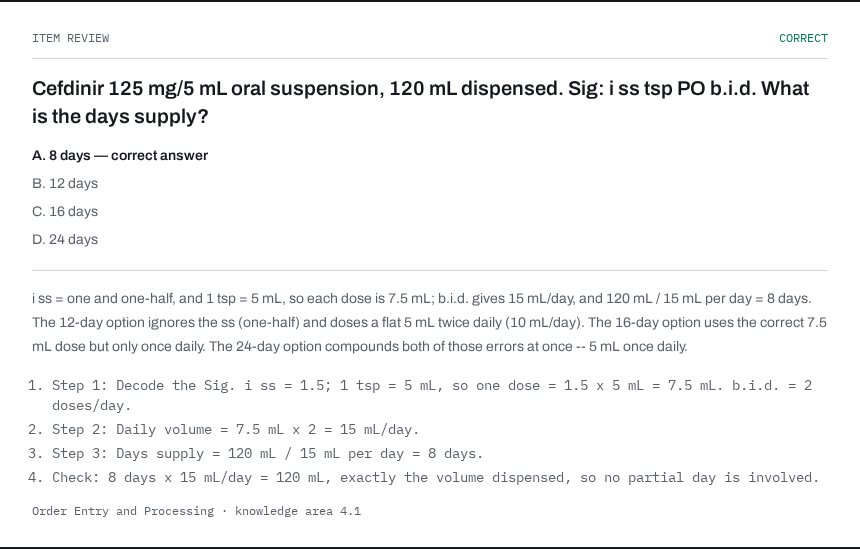
Every item in the review comes with the reasoning for the key and a refutation of each distractor. Every calculation shows the full working, line by line:
A child weighing 44 lb is prescribed acetaminophen 15 mg/kg per dose. What is one dose? A. 150 mg B. 300 mg C. 660 mg D. 1,452 mg
Answer: B — 300 mg. 44 lb ÷ 2.2 lb/kg = 20 kg. 20 kg × 15 mg/kg = 300 mg. C (660 mg) is 44 × 15 — the pound figure used directly, skipping the conversion. This is the single most common error in weight-based dosing items, and the option is there because you will reach for it under time pressure. D (1,452 mg) multiplies by 2.2 instead of dividing. A (150 mg) halves the correct dose.
That level of working is on every calculation in the bank, including the dilution items that people wrongly believe left the exam in 2026. Alligation alternate is out. Concentration and dilution math — C₁V₁ = C₂V₂ — is still squarely in the outline, and we still test it. If calculations are your weak point, the calculations track drills them with the same working shown.
Your results report, and what it deliberately will not tell you
When the clock stops you get:
- your raw percentage on the 80 scored items;
- a per-domain breakdown — scored and missed in each domain, against the 28 / 15 / 19 / 18 blueprint targets, so you can see whether you are 4 down in Federal Requirements or 4 down in Medications, which are entirely different problems;
- time per item, so you can find the questions that quietly ate eleven minutes;
- the ten unscored items, revealed afterward, so you can see what they were.
And here is the most important line on the results screen. It sits there permanently:
The real PTCE reports a scaled score from 1,000–1,600 with a passing score of 1,400. This simulator reports your raw percentage — your real PTCE score is scaled and will differ.
Here is why we will never show you a predicted 1,4-something.
The PTCE's passing score was set by a modified-Angoff standard-setting process, and PTCB equates its parallel forms in advance using item response theory. A scaled 1,400 means the same standard on every form — which is exactly why it does not correspond to a fixed percentage correct. There is no published conversion from raw score to scaled score. Nobody outside PTCB has one.
So a practice product that hands you a predicted scaled score, a percentile, or a pass probability is not being generous with information. It is generating a number out of nothing and dressing it up in the authority of PTCB's scale. We would rather give you a diagnostic you can actually act on: you missed 6 of 15 federal items, go here.
Worth knowing, too: PTCB promises a per-domain breakdown for its own Pre-PTCE® practice product, not for the exam itself. The domain diagnostic you get here is ours, and it is the most useful thing on the page. More on scaled scores, cost and retakes is in the FAQ.
A note on two features you will see: the on-screen calculator here is four-function, and you can flag items to revisit. PTCB does not publish which calculator type the PTCE provides, and a named mark-for-review control is not documented for the PTCE. Both are our design choices, labeled as ours, not claims about the real exam.
How to actually use it between shifts
Take the whole 110 minutes once, early, before you feel ready. The number will be worse than you want and that is the point — you are buying a map, not a grade. Sitting the full form also rehearses the thing no short quiz can teach you: switching from a DEA schedule question to a days-supply calculation to a look-alike/sound-alike pair, 90 times, without losing your place.
Then work the weak domain with drills in the twenty-minute windows you actually have. Then sit a fresh full-length form under the clock again, closer to your test date. If you want the reading list first, start with the PTCB study guide.
When you want more than one form
The first full-length test is free and stays free. If you want the rest of the bank:
Starter — $49, one-time. More full-length forms, each built to the same 90-item, 28 / 15 / 19 / 18 specification, with worked solutions and the per-domain diagnostic throughout.
Full Access — $89, one-time. Everything in Starter plus the domain-targeted question sets, including the Federal Requirements track built around the 2026 outline's new DSCSA knowledge area, and the calculations track with full working on every item.
Both are one-time payments. No subscription, no auto-renew, no monthly billing. Details on the pricing page.