PTCB® Federal Requirements: DEA Schedules, Controlled Substances and DSCSA
On January 6, 2026 the PTCE® content outline changed, and one domain moved further than any other. Federal Requirements went from 12.5% of the exam to 18.75%.
That reads like a rounding decision. It isn't.
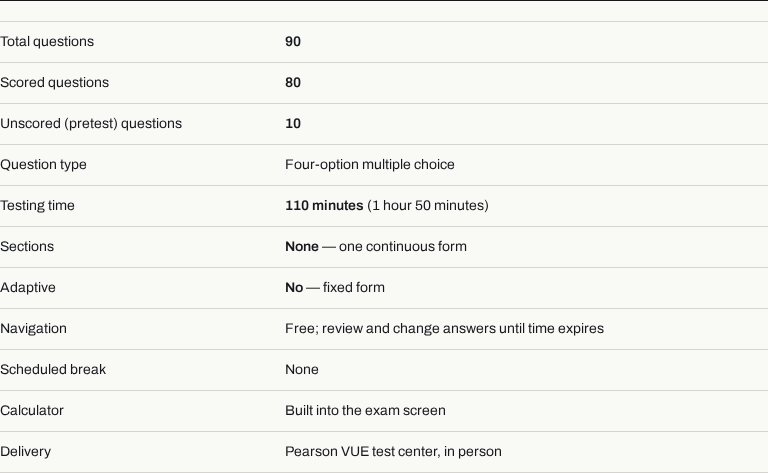
The PTCE has 90 items, 80 of them scored. Federal Requirements used to be 10 of those 80. It is now 15 — a 50% relative increase, and the largest single shift on the exam.
If you are anywhere near the pass line, this is now the domain most likely to decide your result. And almost nobody teaches it as its own track. Most prep material still treats federal law as the short chapter you skim after pharmacology. That was defensible under the 2020 blueprint. It isn't now.
What 15 items looks like on test day
The PTCE is one continuous 90-item form on a single 110-minute countdown. No sections, no per-section timers, no domain labels. PTCB® states items are not presented in content-outline order — they are randomly distributed through the form.
So you will never see a "Federal Requirements section." You will see a Schedule III refill question, then two pharmacology items, then a DSCSA question forty items later. This material has to be recall-ready cold, at any point in those 110 minutes.
The six knowledge areas
Paraphrasing the 2026 outline, Federal Requirements covers:
- Storage, handling and disposal of substances and wastes — including P-list wastes
- Federal requirements for controlled-substance prescriptions (new, refill, transfer) and DEA schedules
- Receiving, storing, ordering, labeling and dispensing controlled substances
- Federal restricted-drug programs and their medication-processing requirements
- FDA medication-recall requirements
- FDA product serialization, tracking, tracing, handling and quarantining requirements — DSCSA. New for 2026.
Areas 2 and 3 carry PTCB's asterisk, meaning some or all of that content is calculation-bearing. Controlled substances are not purely a recall domain.
P-list is newly named. The waste-handling area did not spell out P-list wastes before 2026; it does now. When the body that writes the outline adds a term to it, that term is a question target.
Restricted-drug programs are named as a category, not individually. The outline points at the medication-processing requirements they impose — enrollment, authorization, documentation, dispensing limits — not at any program's clinical content. Study the processing shape: what must be verified before entry, what blocks a fill, what the technician may not resolve alone.
DSCSA: the only genuinely new content on the exam
Everything else in this domain existed under the old blueprint. The Drug Supply Chain Security Act knowledge area did not — which makes it the highest-value thing on this page.
Serialization and product identifiers. DSCSA is a tracing statute: product carries identifiers that let a pharmacy verify what arrived against what was supposed to arrive.
Suspect product. When a dispenser identifies product it cannot verify as legitimate, the obligation is to quarantine and investigate. Not dispense-and-flag. Not hand it back to the driver.
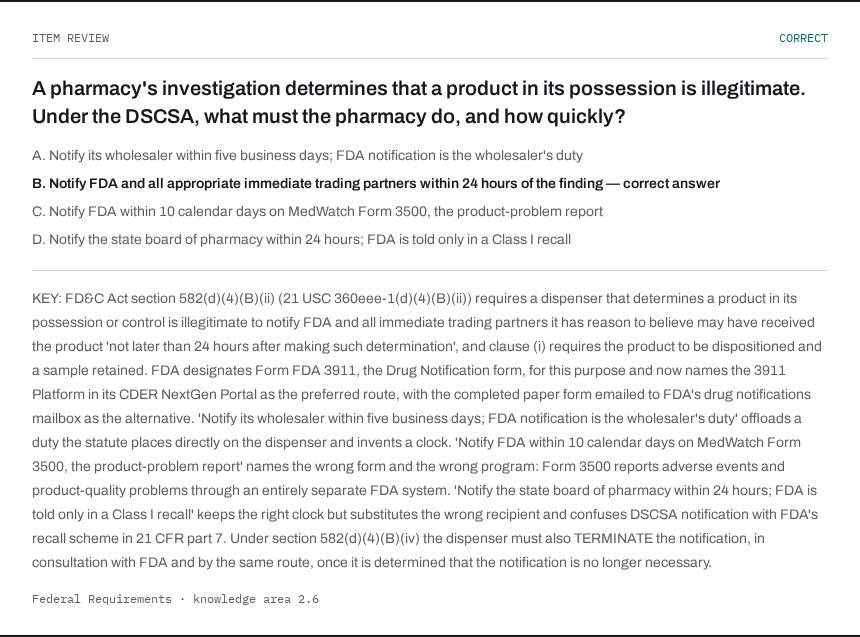
Illegitimate product. If the investigation determines the product is illegitimate, the pharmacy must quarantine and disposition it and notify FDA and all appropriate immediate trading partners within 24 hours of that determination.
Three details are where items get built:
- The 24-hour clock starts at the determination — not at receipt, not at the start of the investigation.
- Notification goes to FDA and trading partners, not FDA alone.
- FDA now names the CDER NextGen 3911 Platform as its preferred notification route; paper Form FDA 3911 is still available.
If you remember one sequence from this page, make it quarantine → investigate → notify within 24 hours of determining illegitimacy.
Controlled substances: the rule most people get half right
Schedule II prescriptions may not be refilled at all under federal law (21 CFR 1306.12).
Schedules III and IV are governed together by 21 CFR 1306.22: no more than five refills, and not more than six months after the date the prescription was issued — whichever limit is reached first.
Candidates learn "C-III: five refills, six months" and then freeze on a Schedule IV stem, because nobody told them one regulation covers both. It does.
And that is the federal ceiling. State law may be stricter, and where it is, the stricter rule controls. A stem saying "under federal law" wants the ceiling; your state board may not let you near it.
For scheduling itself, the discriminator is one clause. Schedule I and Schedule II both describe a high potential for abuse. Schedule I has no currently accepted medical use in the United States; Schedule II has one. Schedules III through V run progressively lower on abuse potential, with accepted medical use throughout.
Recalls: why lot-number literacy pays twice
FDA medication-recall requirements sit here, but the technician's actual recall work — finding affected lot numbers, pulling stock, quarantining, documenting — runs into Order Entry and Processing, where lot numbers, expiry dates and NDC numbers are their own knowledge area. The same skill, scored in two domains.
Five practice items, with the working shown
Original items written to PTCB's published 2026 content outline. Every rationale refutes all three distractors, because on a four-option single-best-answer exam that is the actual skill.
Item 1 — Schedule IV refills
Under federal law, how many times may a Schedule IV controlled-substance prescription be refilled, and for how long?
A. Not at all B. Up to 5 times within 6 months of the date issued, whichever limit is reached first C. Up to 5 times within 12 months of the date issued D. Up to 11 times within 12 months of the date issued
Key: B. 21 CFR 1306.22 governs Schedules III and IV together: no more than five refills, not more than six months from the date issued, whichever comes first. A describes Schedule II (21 CFR 1306.12). C keeps the right refill count but borrows the 12-month calendar from non-controlled practice — the most common wrong answer here. D is that convention outright. Federal ceiling; state law may be stricter.
Item 2 — DSCSA, first action
A delivery arrives with a carton whose packaging does not match the purchase record and whose product identifier cannot be verified. Under DSCSA, what must the pharmacy do first?
A. Dispense the stock and document the discrepancy B. Quarantine the product and investigate C. Hand the carton back to the delivery driver and take no further action D. Destroy the product immediately and document the destruction internally
Key: B. DSCSA requires a dispenser that identifies suspect product to quarantine and investigate it. A fails because suspect product must not be further distributed or dispensed. C returns unverified product to circulation with no investigation and no notification. D destroys the evidence and skips notification, defeating the statute's tracing purpose — the notification duty attaches to the determination, not the disposal.
Item 3 — DSCSA, the clock
A pharmacy's investigation determines that a received product is illegitimate. Within what time frame must FDA and the pharmacy's appropriate immediate trading partners be notified?
A. 24 hours of the determination B. 72 hours of the determination C. 10 business days of the determination D. 30 days of the determination
Key: A. DSCSA sets the window at 24 hours from the determination of illegitimacy. B, C and D are longer windows borrowed from other reporting conventions; none is the DSCSA figure. Note both halves: the clock runs from the determination, and the notice goes to FDA and trading partners. FDA's preferred notification route is the CDER NextGen 3911 Platform.
Item 4 — Schedule I versus Schedule II
Two substances both have a high potential for abuse. One has a currently accepted medical use in the United States; the other does not. Under the Controlled Substances Act, how are they scheduled?
A. Both Schedule I B. Both Schedule II C. The substance with no accepted medical use is Schedule I; the other is Schedule II D. The substance with no accepted medical use is Schedule II; the other is Schedule I
Key: C. The CSA defines Schedule I as high abuse potential with no currently accepted medical use. Schedule II shares the high abuse potential but has an accepted medical use — that clause is the entire discriminator. A and B collapse the distinction; D inverts it.
Item 5 — Schedule II refill request
A patient asks the pharmacy to add a refill to a Schedule II prescription filled last week. What is correct?
A. One refill is permitted within 6 months — process it B. Up to 5 refills are permitted within 6 months — process it C. Schedule II prescriptions may not be refilled under federal law; refer the request to the pharmacist D. Refills are permitted if the prescriber's DEA number is on file — process it
Key: C. 21 CFR 1306.12 prohibits refills on Schedule II prescriptions. A and B import the III/IV allowance from 21 CFR 1306.22 into Schedule II — exactly the error this item catches. D invents a condition that does not exist. The second half matters too: refill and early-fill requests require pharmacist judgment, outside the technician's scope. One item, a Federal Requirements fact and a Patient Safety action — which is how a randomly distributed form behaves.
How to get through this in 20-minute blocks
Schedules. I versus II on the accepted-medical-use clause. Then III/IV under one regulation: five refills, six months, whichever first.
DSCSA. The three-step sequence and the 24-hour clock. Say it out loud until it is one phrase, not four facts.
Waste, storage, restricted programs, recalls. P-list as a named designation; storage-handling-disposal as one chain; the technician's process role in a recall.
Mixed drilling. The block that counts. Recall-in-isolation is what the real form tests, and you only build it by answering federal items scattered among everything else.
Then do it under the clock. Our full-length PTCB practice test runs 90 items in 110 minutes, weighted 28 / 15 / 19 / 18 to the current outline, so the 15 federal items land where they will on the day — unlabeled, between a pharmacology item and a days-supply calculation. The per-domain report tells you how many of those 15 you got.
For the rest of the blueprint, see the PTCE exam guide; for the calculation-bearing areas in all four domains, the PTCB math practice guide; for a study plan built on the 2026 item counts, the PTCB study guide. Access options: pricing.