PTCB® Math Practice: Worked Pharmacy Technician Calculations
Most people study calculations as if they live in one domain. They don't.
Nine knowledge areas carry PTCB®'s asterisk — the mark meaning some or all of that statement reflects calculation-based knowledge — and they are spread across all four domains of the PTCE® content outline. Order Entry and Processing is the obvious home at 22.50%, or 18 of the 80 scored items. But asterisked areas also sit under Medications (strengths, doses, routes, duration of therapy), Federal Requirements (controlled-substance prescriptions, receiving and ordering) and Patient Safety (error-prevention strategies, prescription error types).
A math weakness doesn't cost you one block of the exam. It bleeds across the whole form.
Worth knowing up front: 110 minutes for 90 items is roughly 73 seconds per item on average. A days-supply problem you reason out from scratch eats three items' worth of clock.
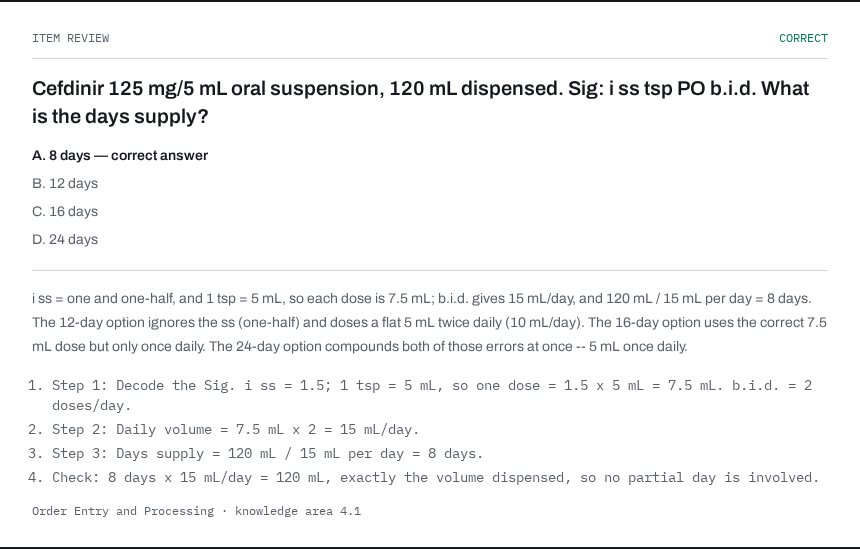
What's still on the exam — and what actually left
The January 6, 2026 outline removed alligations from the calculations area, and removed nonsterile compounding. For the math, that is the whole of it, and it gets reported badly.
What did not leave:
- Dilutions are explicitly still in scope. The current calculations knowledge area names conversions, concentration and dilutions in its own text. C₁V₁ = C₂V₂ is live.
- Reconstitutables are still in scope, under drug stability in the Medications domain.
- Ratios, proportions, conversions, days supply, quantity, dose and concentration are all untouched.
If a study guide tells you there is no more mixing math on the PTCE, put it down. What went is alligation alternate — the tic-tac-toe grid. C₁V₁ = C₂V₂ is a different tool, and it stayed.
The calculator you'll actually have
The PTCE gives you a built-in on-screen calculator. A personal calculator may not be used under any circumstance; a hand-held may be lent by the test center on request. PTCB does not publish what type the on-screen one is. Scratch work goes on a laminated noteboard from the test administrator, and you cannot bring a pen or pencil.
So practice writing units out on paper you didn't choose, with a calculator you didn't choose. Our simulator ships a four-function calculator — our design choice, not a published exam fact — so you get used to working without a memory key.
Seven worked problems
Original items written to PTCB's published 2026 content outline. Every one shows the full working, and every distractor is a real error someone makes.
1 — Days supply
Cephalexin 250 mg/5 mL suspension, 200 mL dispensed. Sig: 1 tsp PO q.i.d. What is the days supply?
A. 5 B. 10 C. 13 D. 20
Working: 1 tsp = 5 mL. q.i.d. = 4 doses/day → 5 × 4 = 20 mL/day. 200 mL ÷ 20 mL/day = 10 days.
Key: B. A = 200 ÷ 40, assuming 2 tsp per dose. C = 200 ÷ 15, assuming t.i.d. D = 200 ÷ 10, assuming b.i.d. Every distractor is a misread frequency — read the Sig before you touch the calculator.
2 — Percentage strength (w/v)
How many grams of sodium chloride are in 1,000 mL of 0.45% NaCl?
A. 0.45 g B. 4.5 g C. 9 g D. 45 g
Working: % w/v means grams per 100 mL. 0.45% = 0.45 g/100 mL. 1,000 mL × (0.45 g / 100 mL) = 4.5 g.
Key: B. A repeats the percentage as the answer. C is right for 0.9% — normal saline, the number your hands know — applied to the wrong strength. D slips the decimal by ten.
3 — Weight-based dose, two steps
A child weighing 33 lb is prescribed amoxicillin 45 mg/kg/day divided b.i.d. How many mg per dose?
A. 337.5 mg B. 675 mg C. 742.5 mg D. 1,485 mg
Working: 33 lb ÷ 2.2 lb/kg = 15 kg. 15 kg × 45 mg/kg/day = 675 mg/day. Divided b.i.d. → 675 ÷ 2 = 337.5 mg per dose.
Key: A. B is the correct daily dose but ignores "divided b.i.d." D = 33 × 45, skipping the lb→kg conversion entirely — the single most common error in this item type. C = that same unconverted figure divided by two, so it makes both mistakes and one correction. If the stem gives pounds, convert first, before anything else.
4 — IV flow rate
500 mL of D5W is to infuse over 4 hours. The set delivers 20 gtt/mL. What is the drip rate, to the nearest whole drop?
A. 21 gtt/min B. 31 gtt/min C. 42 gtt/min D. 125 gtt/min
Working: 500 mL ÷ 4 h = 125 mL/h. 125 ÷ 60 = 2.0833 mL/min. 2.0833 × 20 gtt/mL = 41.67 → 42 gtt/min. Cross-check: (500 mL × 20 gtt/mL) ÷ 240 min = 10,000 ÷ 240 = 41.67 ✓ — two routes, same answer.
Key: C. A uses a 10 gtt/mL set, B a 15 gtt/mL set. D is the mL/h rate wearing a gtt/min label. The drop factor is in the stem for a reason; it is never optional.
5 — Dilution, C₁V₁ = C₂V₂
How many mL of a 1:200 solution are needed to prepare 1,000 mL of a 1:5,000 solution?
A. 4 mL B. 25 mL C. 40 mL D. 200 mL
Working: 1:200 = 1 g in 200 mL = 1,000 mg / 200 mL = 5 mg/mL. 1:5,000 = 1,000 mg / 5,000 mL = 0.2 mg/mL. C₁V₁ = C₂V₂ → 5 × V₁ = 0.2 × 1,000 = 200 mg → V₁ = 200 ÷ 5 = 40 mL. Cross-check by dilution factor: 5,000 ÷ 200 = 25-fold dilution; 1,000 ÷ 25 = 40 mL ✓.
Key: C. A slips a decimal. B mistakes the dilution factor (25) for the volume. D treats it as a 5-fold dilution. Convert ratio strengths to mg/mL before you touch C₁V₁ = C₂V₂ and this becomes one line of arithmetic.
6 — Taper quantity from a Sig
Prednisone 20 mg tablets. Sig: 3 tabs PO daily × 3 days, then 2 tabs daily × 3 days, then 1 tab daily × 3 days. What quantity is dispensed?
A. 6 B. 9 C. 18 D. 27
Working: (3 × 3) + (2 × 3) + (1 × 3) = 9 + 6 + 3 = 18 tablets.
Key: C. A adds the daily quantities once (3 + 2 + 1) and forgets each step runs three days. B counts only the first step. D runs 3 tabs across all nine days. Tapers reward writing out one line per step instead of doing it in your head.
7 — Insulin days supply
A patient injects 24 units of insulin glargine subcutaneously once daily. How many days will one 10 mL vial of U-100 insulin last?
A. 24 days B. 41 days C. 42 days D. 100 days
Working: U-100 = 100 units/mL. A 10 mL vial holds 10 × 100 = 1,000 units. 1,000 ÷ 24 = 41.67 → 41 whole days.
Key: B. C is the trap: 41.67 rounds up to 42 in ordinary arithmetic, but a partial day is not dispensed as a day of supply, so you truncate. A restates the dose. D reads the vial as a 100-day supply. Days supply always rounds down.
Sig codes and Roman numerals
The calculations knowledge area also covers Sig codes, abbreviations, medical terminology and symbols. Roman numerals in a Sig stay small: i = 1, ii = 2, iii = 3, v = 5, x = 10.
Decode this: "i gtt AU b.i.d. × 7d"
A. One drop in each eye twice daily for 7 days B. One drop in each ear twice daily for 7 days C. One drop in the left ear twice daily for 7 days D. One tablet by mouth twice daily for 7 days
Key: B. i = 1; gtt = drop; AU = each/both ears; b.i.d. = twice daily. A swaps in OU (each/both eyes). C uses AS (left ear). D ignores the dosage form.
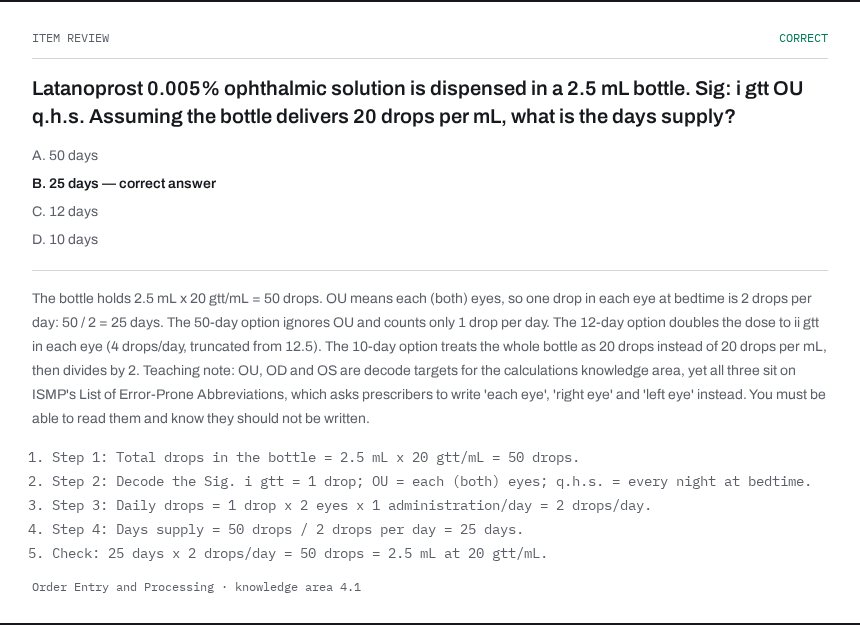
The point most guides miss. OD / OS / OU and AD / AS / AU appear in the 2026 outline twice, for opposite reasons. The Order Entry area expects you to decode them. The Patient Safety area expects you to limit error-prone abbreviations — and these are on ISMP's error-prone list, where the correction for the eye set is "Use 'right eye,' 'left eye,' or 'each eye'."
Both are true at once. On a decode item, translate it. On a safety item, flag it. Knowing which question you're being asked is the skill.
NDC numbers
The current 11-digit NDC format runs 5-4-2:
- First five digits — labeler. The manufacturer, repackager or distributor.
- Middle four — product. The specific drug: strength, dosage form, formulation.
- Final two — package. FDA states this segment identifies package sizes and types.
In the current 11-digit format, what does the middle four-digit segment identify?
A. The labeler B. The specific product — strength, dosage form and formulation C. The package size and type D. The expiration date
Key: B. A is the first segment, C the last. D is not encoded in an NDC at all; expiry and lot are printed separately on the package — which is why the outline lists lot numbers, expiry dates and NDC numbers together as one knowledge area, and why recall handling leans on all three.
One currency note, because it will come up. On March 5, 2026 FDA finalized a rule moving FDA-assigned NDCs to a 12-digit, 6-4-2 format, effective March 7, 2033, with a three-year transition. The format you are tested on now is the 11-digit one, and the last two digits stay the package code either way. Say "the current 11-digit format" rather than "an NDC is always 11 digits" and you're accurate in both eras.
Drilling this in 20-minute blocks
Conversions only. lb→kg, tsp→mL, % w/v→g per 100 mL, ratio strength→mg/mL. No word problems. Just units, until they're reflex.
One problem type at a time. Twenty days-supply items in a row teaches the pattern faster than twenty mixed ones.
Then mix them. The real form never tells you which type is coming, and items are randomly distributed rather than grouped by domain.
Then add the clock. Roughly 73 seconds an item is what turns a method you know into a method you can use.
Our full-length PTCB practice test runs 90 items in 110 minutes with calculation-bearing items scattered across all four domains, as the outline describes, and shows the full working in review rather than just the letter. For the blueprint and scoring, see the PTCE exam guide; for the domain that grew most in 2026, the Federal Requirements guide; for a study plan built on the 2026 item counts, the PTCB study guide. Access options: pricing.